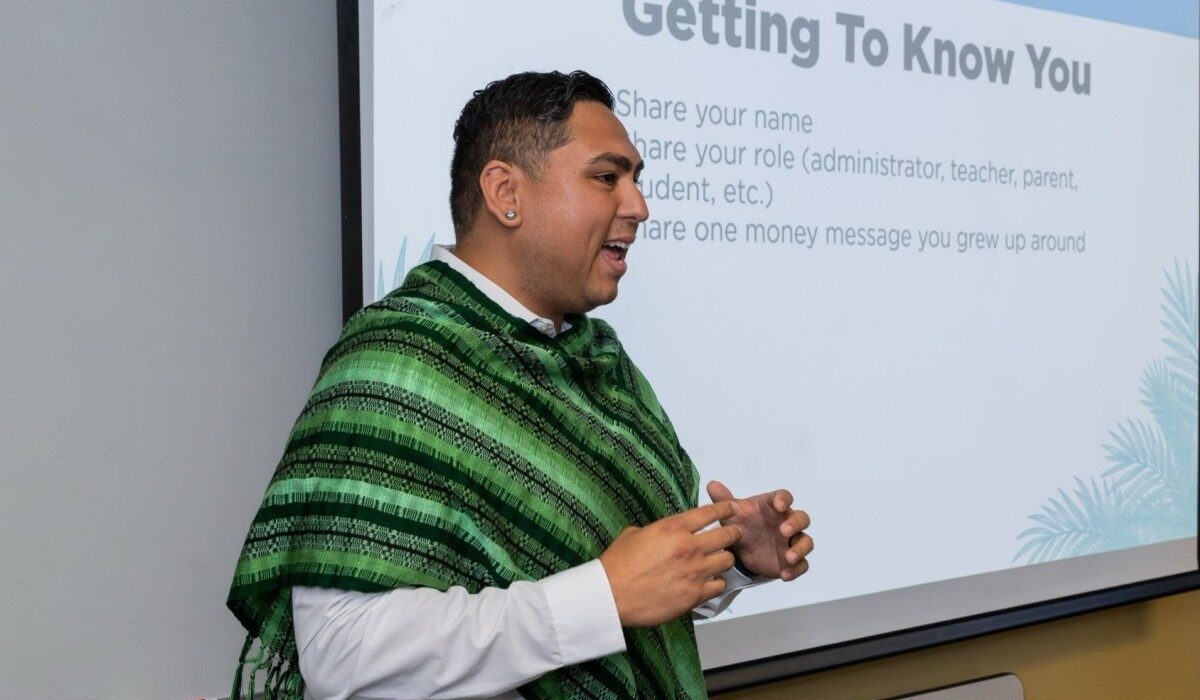
100 days into this role, I keep coming back to the same realization: this work is not just about programs or policy, even as both matter. It is the educators who make learning come alive for young people every day, and the people serving our communities.
As the son of parents who immigrated from Tijuana, Mexico, and as a former public school teacher and principal, I have seen firsthand how education can transform the trajectory of a life.
That belief brought me to the California Council on Economic Education (CCEE), and it continues to ground me as California prepares for AB 2927, which requires districts to offer a stand-alone personal finance course starting in the 2027-28 school year, becoming a graduation requirement for the class of 2030-31.
For nearly 70 years, CCEE has shaped economics and financial literacy education across our state by serving educators, young people and families. This moment calls on us to build on that legacy while evolving to meet the needs of a changing world.
From day one, I committed myself to listening and learning.
I have heard from:
- District and county leaders as well as educators preparing for California’s new personal finance requirement
- Community leaders expanding opportunity for young people and families
- Funders and partners investing in long-term economic mobility and resilience
- Board members, staff and supporters deeply committed to our mission
One theme has emerged again and again: we have an opportunity to build a stronger, more connected ecosystem around economic and personal finance education.
There is growing momentum to ensure every young person has access to a strong stand-alone personal finance course in high school. That work is critical, and we must lean in to strong curricular materials and well-equipped educators.
But preparation for that moment doesn’t begin in high school. Young people build economic and financial understanding over time — early concepts of choice, saving and tradeoffs in elementary school; more complex ideas about systems, incentives and decision-making in middle school; applied personal finance in high school, grounded in economic reasoning. These are not separate efforts. They are a single, coherent continuum of learning.
At times, economics and personal finance are treated separately — one focused on money decisions, the other on how economies work. But young people experience them together. Every financial decision exists within a broader economic context. That is why the two must go hand in hand.
And if we are serious about expanding access to both, we must invest in the educators who make that learning possible. A graduation requirement alone does not change lives. Curriculum alone does not change lives. Educators do.
From transitional kindergarten through 12th grade, they help students make sense of the world, think critically, understand systems and make informed decisions. They are the bridge between standards and student success.
At CCEE, our role is not only to support implementation, but to engage, empower and equip educators with the tools, training and community they need. That is what led us to launch two new programs in partnership with Dr. Cheryl A. Ayers, MBA, PhD — a Personal Finance Institute and an Entrepreneurship Institute. The time to act is now.
We also have a responsibility to convene a coalition — educators, school districts, nonprofits, financial institutions, philanthropists, and partners — because preparing young people for the future is shared work.
More than anything, this work is about belief. At CCEE, we believe:
- A young person’s future should not be determined by their zip code
- Knowledge creates agency and resilience, especially in this increasingly complex world
- When young people, educators and families understand both how money works and how economies work, they are better equipped to build the futures they envision
California is entering a pivotal moment as the fourth largest economy in the world. Opportunities are rising, systems are shifting, and the demand for economic and financial literacy has never been greater. Our responsibility is to make sure young people understand not only what to do with money, but the economic forces that shape those decisions. That is where opportunity lives.
We are just getting started — and this work is stronger with you in it. If it resonates, consider making a gift at ccee.org/donate, and stay connected with us in the year ahead at ccee.org.